On the last day of this year’s AMCIS (America’s Conference on Information Systems), which takes place in Reno, I finally get to writing about an experience I have had during last year’s AMCIS in Montreal. This concerns the way that Air Canada handled bookings ahead of an imminent strike by its flight attendants. The fotos I will be peppering this post with are, however, mostly from this year, when I spent four wonderful days of hiking west of Reno in the Sierra Nevada, near Truckee, a little town along the railway between Reno and Sacramento. That railway tells its own story about infrastructure building, as it was the most challenging bit in connecting the East and the West coast through what eventually became the Pacific Railroad, carved through the Sierras mostly by Chinese and Irish immigrants. Check out this video on how the most grueling tunnel under the Donner summit was made. The place also tells the story of the Washoe people who spent the summer in the mountains, mostly fishing and conserving food for the winter, and the settlers, who tried to overcome the Sierra mountains on their way West, including the sad story of the Donner Party, the name giver to both Donner lake and Donner pass, when half of them perished in the first attempt to cross the Donner pass.

Working on the presentation of a paper for last year’s AMCIS that I had written together with Yumei Luo from Yunan University on telemedicine practices in China on August 14, I reveived an email by Air Canada that informed me about the the risk of an upcoming strike. In that email, I was offered the possibility to change my flight, scheduled for August 17, at no additional cost to a later date, which appeared to be a fair offer. However, it then said this:
“If you opt to keep your current booking and your flight is cancelled due to a labour disruption, Air Canada will attempt to rebook you on another flight, including those operated by other airlines. However, available capacity on our airline and on other carriers is limited due to the summer travel peak, meaning the possibility of rebooking you within an acceptable timeframe is low. Customers booked on flights that are cancelled will also have the option to obtain a full refund.”
I almost panicked because I had to return on time to help organize the funeral of my dear father. Luckily, I remembered that I had booked with Lufthansa, not with Air Canada, so I called my travel agent who then rebooked me on an Air Swiss flight, which, it turned out, was the only flight going out on the day of my scheduled departure, so that I safely and punctually returned home.
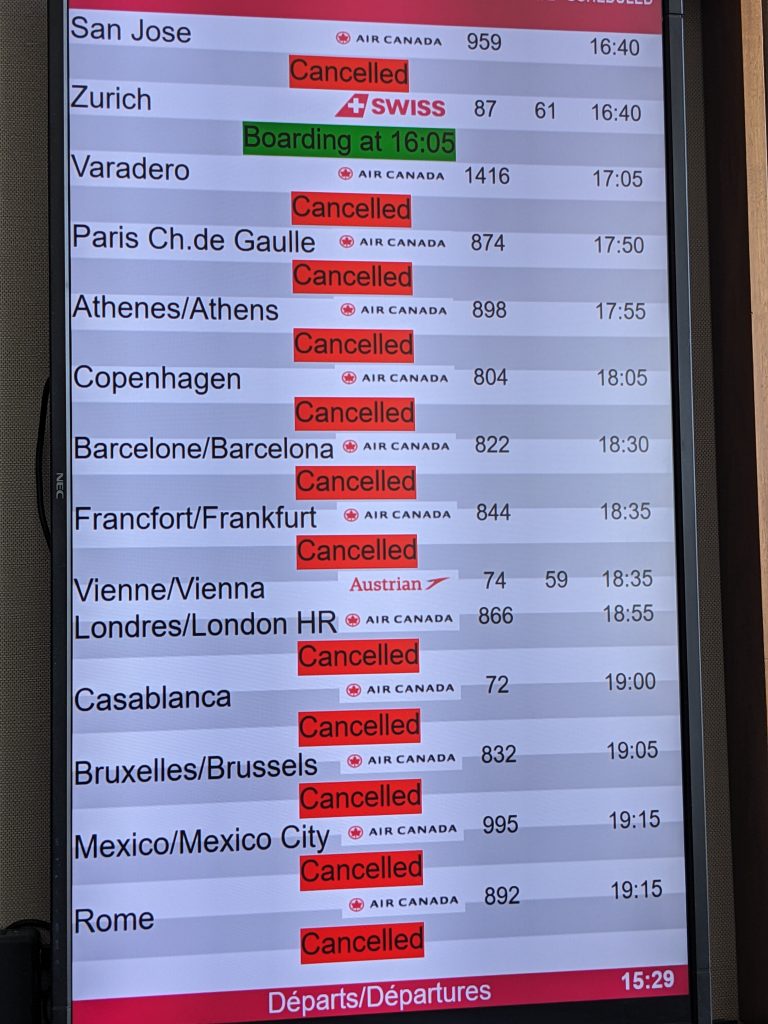
Departure screen on the day I flew out of Montreal, as planned on August 17; my original flight with Air Canada to Frankfurt was eventually cancelled, albeit only shortly after I arrived at the airport
The unfolding of events over the following days was then quite dramatic. I here just quote the headlines of the news published by Air Canada to keep their customers up to date (CUPE: Canadian Union of Public Employees; CIRB: Canada Industrial Relations Board):
August 16
Air Canada and Air Canada Rouge Operations Remain Suspended Pending Outcome of CIRB ProcessAugust 17
Air Canada Suspends Plans to Restart Operations after CUPE Defies CIRB Directive to Return to WorkAugust 17
Air Canada to Restart Flights Following Government Referral of CUPE Negotiations to Binding ArbitrationAugust 18
Air Canada and Air Canada Rouge Operations Remain SuspendedAugust 18
CIRB Declares Flight Attendant Strike at Air Canada Unlawful and Orders CUPE Leaders to Direct Flight Attendants Back to WorkAugust 19
Air Canada to Gradually Resume Service Today after Reaching a Mediated Settlement with its Flight Attendant Union
So operations gradually resumed only on August 19, two days after my scheduled flight. Had I not been able to rebook via Lufthansa to Air Swiss, I would have come too late for helping to arrange the funeral of my father. In fact, I later learned from a colleague that he was stuck in Toronto for five days due to the strike.

Now, I must say that I fully sympathized with the cause of the flight attendants. While their hourly wage rate seemed okay to me, there was a curious clause in their contracts which stipulated that they would only be paid when the aircraft was rolling. All work needed before the aircraft got rolling and after it parked at the destination was unpaid! This is the clause they fought.
Upon reflecting on that experience, I gradually came to the conclusion that the possibilities of digitalization are increasingly being used to shift risks, especially by infrastructure operators such as airlines and rail companies, most notoriously the Deutsche Bahn (the German main rail operator). In this case, Air Canada shifted the risk of flights being cancelled to the customer, under the veil of a generous offer (free re-booking). The problem was that, as a customer of Air Canada, you had to make a very difficult decision: should you rebook to a later date or take the risk that the flight would eventually be cancelled? Air Canada would officially cancel a flight only at the very last moment, in my case the originally scheduled flight was only cancelled after I arrived at the airport, and only then could the customer demand rescheduling. But how could such a decision be made in a rational manner? As the unfolding of events shows, the likelihood of the flight beeing cancelled was practically impossible to predict. And Air Canada had warned its customer that, should a scheduled flight eventually be cancelled, the chance of being rescheduled was rather low.
What would have been the alternative that would have relieved the customer of making such an impossible decision? Well, they could have set up an emergency plan, trying to serve as many customers as possible, and reschedule all others by cancelling their flights well in advance, thus absorbing the risk that a flight could not be operated. I don’t know whether this is standard procedure with other airlines, but I notice a general trend that also became manifest in the actions of Air Canada: to replace committment by probability.

In Aachen, the city where I live, there is a so-called weather tower, modelled after a similar, but now defunct installation in New York. It consists of a column and a globe mounted on top of a building next to the main railway station. Each part has a separate function. The globe sends five signals:
- Blue: clear sky
- Yellow: overcast sky
- White: percipitation
- Constant light: steady wheather conditions
- Flashing light: changing wheather conditions
The column sends three signals:
- Light rises from bottom to top: rising temperature
- Light descends from top to bottom: falling temperature
- Light remains constantly on: no change in temperature
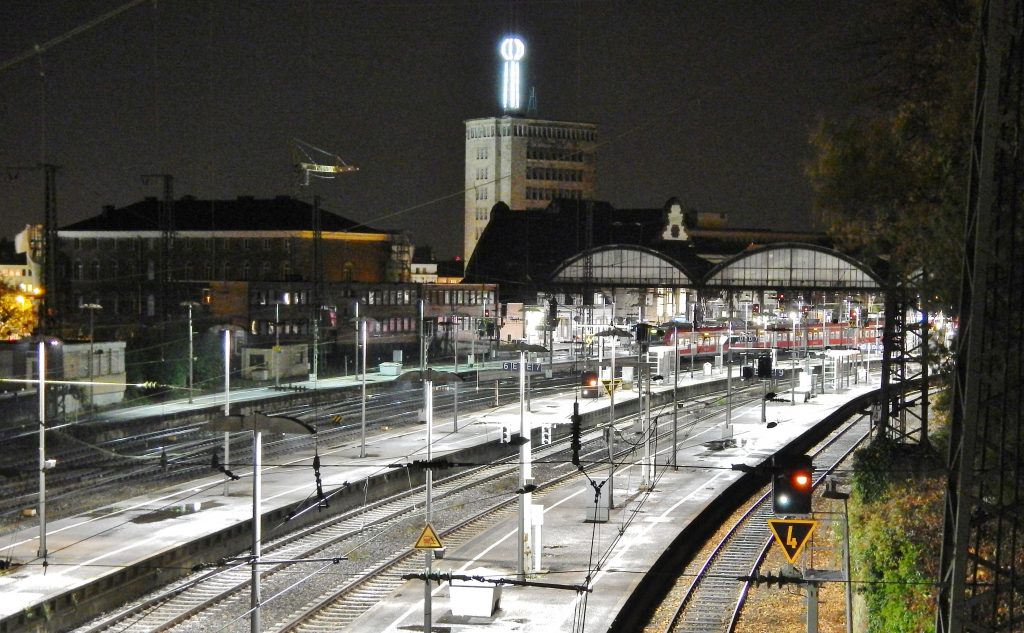
The wheather tower in Aachen; here it predicts percipiation on the next day; source: Wikipedia, quesy quesy
I can see the tower from our apartment. It gives a clear indication on what to expect on the next day. For example, if it flashes white, I know that, on the next day, there will be rain and that the weather will be changeable. It does not say at what time to expect rain, but it committs to saying that there will be rain. Of course, the prediction is sometimes wrong, but overall I have found it to be very reliable.
Now compare this to the weather forecast we all see on our mobile phones. There, we receive seemingly much more precise information: with which probability to expect rain on the next day, hour by hour. That looks like an improvement. You receive the information earlier (the wheather tower will start sending the signal only after dusk for the next day) and it gives you an indication of how much percipitation to expect and at which time of the day. But, naturally, there is a large margin of error which is not shown and which implies that the prediction will change frequently. An hour ago, you were told to expect rainfall on the next day. Now, it seems that it will not rain on the next day. Even more confusingly, it might acutally show rainfall for the present moment when, evindently, it does not rain. The reason is that it only gives a probability, that might reach back into the present. My concrete problem is this: should I bring an umbrella or not when going out? Based on the signal sent by the weather tower, I have a clear, actionable piece of information. If, on the previous evening, it predicted rainfall, I will bring one. But what should I do if my mobile phone predicts rainfall with a probability of 40% for the next hour?
While the information provided by the automated wheather forecast offered on our various online devices seems more precise, the information offered by the weather tower is more reliable. The reason is that someone committs to a prediction and that this prediction is limited to those aspects that can be predicted with relative certainty. The margin of error is much lower if you only predict that it will rain on the next day rather than having to specify this prediction for each hour of the next day. In the case of predictions shown by the weather tower, that someone is the German Weather Service from whom the data are obtained by the local utilities that operate the tower.
In my first post on this blog I had mentioned the app of Deutsche Bahn (DB, the main German rail operator), suggesting that it is more reliable than the train operations themselves. This is still correct; it rarely stops functioning or gives wrong information (if it does, you are completely lost); but I now see it performing a more uncanny job too, namely as facilitating a move away from committment to probability. While DB still publishes an official schedule, its customers tend to rely on this less and less as, in fact, trains have come to be so unreliable (in the first half year of 2026, less than 60% of long distance trains where on time). Instead, customers, will rely on the app to figure out when their train will actually arrive or depart. The deviations are considerable (a delay by less than six minutes still counts as ‘on time’), often exceeding one hour. However, it might be that the train arrives actually much earlier; if you missed it because a delay was predicted while the train actually came on time or with less delay than predicted, DB would not resume any responsibility — the shown delay was not a committment but only a statement of a probability, and like the weather forecast on your mobile device, that prediction may continually change.
So what is the upshot of all this? By offering seemingly more precise information, by being more ‘customer oriented’ — was it not nice of Air Canada to inform its customers of the risk of a strike and to offer flexible rebooking? — operators can unload uncertainty and the associated risk to their customers. The mechanism behind this is a replacement of committment by probability. Committment implies that someone takes responsibility for an action and accepts accountability in case the action was not or could not be performed as promised. Of course, that someone might be wrong, and for good reasons. After all, to err is human. However, by replacing committment by probability, the need for taking responsibility and accepting accountability is eliminated. No one is accountable for a prediciton just based on probability. That is even the nature of probability that in so and so many cases it will be wrong, and this is presented as a kind of natural fact, a piece of data. When Air Canada informed its customers, it was treating the risk of an upcoming strike as a phenomenon of nature, in which it had no involvement. The possibilities of digitalization, in this case of instant, real-time communication with its customers, became the excuse for a failure to make a committment.

Incidentally, the paper I presented on this year’s AMCIS, written together with Xunhua Guo from Tsinghua University, talks about the risks of using LLMs (Large Language Models, driving services such as ChatGPT and Gemini) for doing research. There are some parallels between this case and the problem of replacing committment by probability.